
What Is the Difference Between Nordic and Scandinavian?
Have you ever heard someone use the words Nordic and Scandinavian interchangeably and wondered whether they mean the same thing? You’re not alone! These two terms are closely connected, and both describe countries in Northern Europe. However, they don’t have exactly the same meaning.
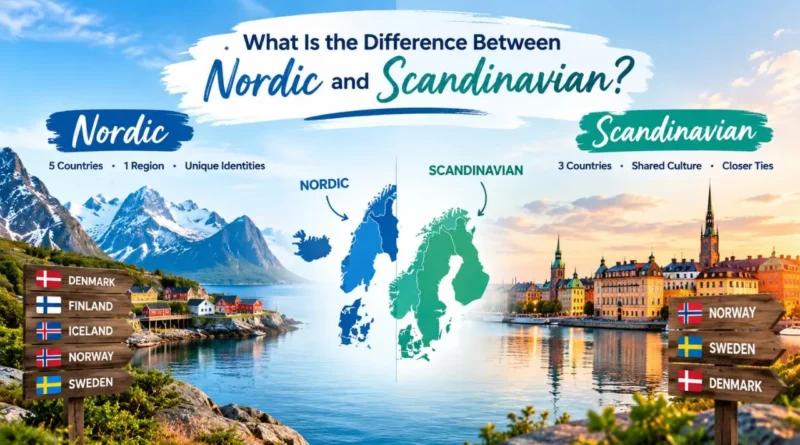
The main difference is simple: Scandinavia usually refers to Denmark, Norway, and Sweden, while the Nordic countries include Denmark, Norway, Sweden, Finland, and Iceland, along with several associated territories.
Think of Scandinavia as one part of a bigger Northern European family. The Scandinavian countries share deep historical, linguistic, and cultural connections, while the Nordic region brings together an even wider group of countries and territories with strong regional ties.
Understanding the difference between Nordic and Scandinavian can help you avoid common geographical mistakes, better understand European history, and appreciate the unique identities of these countries.
So, let’s break it all down in simple terms.
What Does Scandinavian Mean?
The word Scandinavian generally refers to the people, languages, cultures, and geographical region associated with Denmark, Norway, and Sweden.
These three countries share many historical connections. Their languages also belong to the North Germanic language family, making Danish, Norwegian, and Swedish closely related.
Although each country has its own identity, traditions, and national characteristics, centuries of interaction have created strong cultural links among them.
Which Countries Are Considered Scandinavian?
In the most common definition, Scandinavia consists of three countries:
- Denmark: Known for its historic cities, coastal landscapes, cycling culture, and concept of hygge, which describes a feeling of coziness and comfort.
- Norway: Famous for its dramatic fjords, mountainous scenery, northern lights, and maritime history.
- Sweden: Recognized for its forests, lakes, innovative industries, and cultural influence across Northern Europe.
These countries form the traditional core of Scandinavia.
It’s worth noting that some geographical definitions use Scandinavian Peninsula more narrowly to refer primarily to Norway and Sweden, along with parts of northern Finland. This is why geographical Scandinavia and cultural Scandinavia aren’t always identical.
The Historical Origins of Scandinavia
Scandinavia has a long and fascinating history shaped by migration, trade, kingdoms, and maritime exploration.
During the Viking Age, roughly from the late eighth century to the eleventh century, people from what are now Denmark, Norway, and Sweden traveled throughout Europe and beyond. They traded goods, established settlements, explored new territories, and influenced the development of several European societies.
Over time, these countries developed distinct national identities while maintaining strong connections through language, royal relationships, trade, and shared traditions.
The term Scandinavia eventually became a useful way to describe this closely connected cultural and historical region.
Scandinavian Languages and Cultural Connections
Language is one of the clearest reasons Denmark, Norway, and Sweden are grouped together.
Danish, Norwegian, and Swedish are closely related North Germanic languages. Their similarities mean that speakers can often understand parts of one another’s languages, although pronunciation, vocabulary, and everyday expressions can differ.
For example, the words for house are similar across these languages:
- Danish: hus
- Norwegian: hus
- Swedish: hus
Their cultural connections also extend to literature, design, food, architecture, and social traditions.
However, shared characteristics don’t mean everyone follows the same customs. Each country has its own regional differences, historical experiences, and cultural expressions.
What Does Nordic Mean?
The word Nordic refers to a broader Northern European region that includes the Scandinavian countries and several additional countries and territories.
The Nordic concept reflects geographical proximity, historical relationships, cultural connections, and cooperation between neighboring societies.
In everyday usage, the Nordic countries are Denmark, Finland, Iceland, Norway, and Sweden.
This broader definition is the key to understanding the difference between Nordic and Scandinavian.
Which Countries Are Considered Nordic?
The five Nordic countries are:
- Denmark
- Finland
- Iceland
- Norway
- Sweden
The Nordic region also includes several self-governing territories associated with these countries, notably Greenland, the Faroe Islands, and Åland.
Although these countries share regional connections, they aren’t identical in language, ethnicity, geography, or cultural traditions.
For instance, Finland has a language that belongs to a different language family from Danish, Norwegian, and Swedish. Iceland, meanwhile, has a distinctive island history and a language that preserves many features of older Norse.
The Nordic Countries Explained
Let’s take a closer look at the five countries that make up the Nordic region and what makes each one unique.
Denmark
Denmark is both a Scandinavian country and a Nordic country. It consists of the Jutland Peninsula and numerous islands, with Copenhagen serving as its capital.
The country is known for its historic architecture, coastal communities, bicycle-friendly cities, and design traditions. Danish society is also frequently associated with hygge, a cultural concept centered on comfort, warmth, and enjoying everyday moments.
Denmark’s historical connections with Norway and Sweden make it an important part of Scandinavian history.
Norway
Norway is another country that belongs to both Scandinavia and the Nordic region.
Its landscape features steep mountains, deep fjords, glaciers, forests, and an extensive coastline. These natural features have shaped Norwegian life for centuries, influencing fishing, shipping, settlement patterns, and outdoor recreation.
Norwegian is closely related to Danish and Swedish, although its written standards and regional dialects add considerable variety.
Norway is also well known for its outdoor lifestyle and strong connection to nature.
Sweden
Sweden is the largest of the three traditional Scandinavian countries by land area and is also part of the Nordic region.
Its landscape includes extensive forests, thousands of lakes, islands, and long stretches of coastline. Stockholm, the capital, combines historic neighborhoods with modern architecture and urban development.
Sweden has influenced global music, fashion, technology, design, and manufacturing. Its language, Swedish, belongs to the North Germanic family and shares many similarities with Danish and Norwegian.
Finland
Finland is Nordic, but it isn’t usually considered Scandinavian under the traditional definition.
Its geographical position, historical connections with Sweden, and close cooperation with neighboring Nordic countries make it an essential part of the Nordic region.
The Finnish language is especially important to this distinction. Unlike Danish, Norwegian, and Swedish, Finnish belongs to the Uralic language family.
Finland is known for its forests, lakes, saunas, northern landscapes, and strong educational traditions. Finnish culture has its own distinctive identity, even though the country shares many regional connections with Scandinavia.
Iceland
Iceland is a Nordic island country in the North Atlantic Ocean.
Its landscape includes volcanoes, glaciers, waterfalls, lava fields, and geothermal hot springs. These features give Iceland a natural environment that differs considerably from those of mainland Scandinavia.
Icelandic is a North Germanic language with strong historical links to Old Norse. However, Iceland’s island geography and distinct cultural development have shaped its own national identity.
Iceland is unquestionably Nordic, but it is not usually included in the narrow, traditional definition of Scandinavia.
What About Greenland, the Faroe Islands, and Åland?
The Nordic region includes more than five sovereign countries. It also encompasses several territories with different constitutional arrangements.
- Greenland: An autonomous territory within the Kingdom of Denmark, located geographically in North America.
- The Faroe Islands: A self-governing archipelago within the Kingdom of Denmark, situated in the North Atlantic.
- Åland: An autonomous, Swedish-speaking archipelago belonging to Finland.
These territories have their own distinctive histories, languages, and local identities. Their inclusion in the Nordic community reflects political relationships and regional cooperation rather than a simple geographical definition.
Greenland is an especially useful example of why the term Nordic doesn’t simply mean every place located in Northern Europe.
Nordic vs. Scandinavian: The Key Differences
Now that we’ve defined both terms, let’s compare them directly.
The most important distinction is that Scandinavian usually describes a narrower cultural and historical group, while Nordic refers to a broader regional community.
However, geography, language, culture, and politics each offer a slightly different perspective.
Differences in Geography
Geographically, Scandinavia and the Nordic region overlap, but their boundaries aren’t identical.
Scandinavia generally refers to Denmark, Norway, and Sweden in its cultural sense. The Scandinavian Peninsula, meanwhile, primarily includes Norway and Sweden and extends into northern Finland.
The Nordic region includes all five Nordic countries, plus Greenland, the Faroe Islands, and Åland within the broader regional framework.
This distinction matters because geographical regions don’t always match political or cultural groupings.
Differences in Language
Language provides one of the clearest distinctions between the two terms.
Danish, Norwegian, and Swedish belong to the North Germanic language family. They developed from related historical languages and retain many similarities.
Finnish, by contrast, belongs to the Uralic language family. It isn’t a Germanic language and is not closely related to Danish, Norwegian, or Swedish.
Icelandic is a North Germanic language, but it has developed along a distinct path and is not generally mutually intelligible with mainland Scandinavian languages in everyday conversation.
The Nordic region therefore contains several language traditions rather than one shared language group.
Differences in Culture and History
Scandinavian culture is often associated with shared historical experiences among Denmark, Norway, and Sweden, including Viking history, closely related languages, and centuries of political interaction.
Nordic culture encompasses these connections while also recognizing the separate traditions of Finland and Iceland.
For example, Finnish sauna culture is an important part of Finnish identity, while Iceland has a distinctive literary tradition rooted in medieval Icelandic sagas.
Nordic countries also share certain contemporary cultural associations, including outdoor recreation, environmental awareness, and well-developed public institutions. Still, these characteristics vary across countries and shouldn’t be treated as universal descriptions of every individual.
Differences in Politics and Government
The Nordic countries are often grouped together because of their cooperation on political, economic, and social issues.
The Nordic Council and Nordic Council of Ministers provide frameworks for cooperation among Denmark, Finland, Iceland, Norway, Sweden, and their associated autonomous territories.
Nordic countries are frequently associated with social welfare systems, public services, and relatively high levels of social trust. However, their laws, taxation systems, and political arrangements differ.
The Scandinavian countries participate in this wider Nordic cooperation, but the Nordic identity extends beyond their shared historical and linguistic connections.
Are Scandinavian and Nordic People the Same?
Not necessarily.
A Scandinavian person generally comes from Denmark, Norway, or Sweden, although the precise meaning of the label can depend on context and individual identity.
A Nordic person may come from any of the five Nordic countries or have a connection to the broader Nordic region.
For example, someone from Finland is Nordic but isn’t usually described as Scandinavian in the traditional sense. Similarly, an Icelander is Nordic, but the label Scandinavian is less precise for describing their national identity.
Of course, individuals may describe their own identities in different ways. Nationality, ancestry, language, and cultural background don’t always fit neatly into geographical categories.
The simplest approach is to use the term that accurately reflects the country or identity you’re discussing.
Is Finland Scandinavian or Nordic?
Finland is generally considered Nordic, not Scandinavian.
The distinction comes from a combination of language, history, and conventional regional definitions.
Unlike Danish, Norwegian, and Swedish, Finnish is a Uralic language. This linguistic difference sets Finland apart from the traditional Scandinavian language group.
However, Finland has deep historical connections with Sweden. Sweden governed Finland for centuries before Finland became an autonomous grand duchy under the Russian Empire in 1809. Finland declared independence in 1917.
Today, Finland maintains strong political, economic, and cultural relationships with the other Nordic countries.
You’ll sometimes see Finland included in broader discussions of Scandinavian culture or Northern European society. Nevertheless, when precision matters, describing Finland as Nordic is the safest choice.
Is Iceland Scandinavian or Nordic?
Iceland is Nordic, but not usually Scandinavian under the narrow traditional definition.
Its historical roots connect it to Norse settlers, many of whom came from Norway during the settlement period beginning in the ninth century. Icelandic also belongs to the North Germanic language family.
These connections explain why Iceland is sometimes associated with Scandinavian culture.
However, Iceland developed its own distinct national identity, shaped by its island location, settlement history, literature, and political development.
Today, Iceland is an independent country and an established member of the Nordic community.
If you’re discussing Iceland alongside Denmark, Finland, Norway, and Sweden, the term Nordic countries is the clearest and most inclusive expression.
Why Are Nordic and Scandinavian Countries Often Grouped Together?
The Nordic and Scandinavian countries are often discussed together because they share geographical proximity, historical connections, and several broad social and cultural similarities.
Their populations have interacted through trade, migration, political unions, and cultural exchange for centuries.
In modern times, Nordic cooperation has strengthened these relationships through joint initiatives involving education, research, labor mobility, environmental protection, and regional development.
The countries are also frequently compared because many have developed extensive public services and social safety nets. While their systems differ, these similarities make the region interesting to researchers, travelers, and policymakers.
Tourism is another reason the terms are often confused. Travel articles may group Nordic destinations together because they offer similar experiences, such as dramatic natural scenery, winter activities, coastal towns, and opportunities to see the northern lights.
Still, grouping these countries together shouldn’t mean overlooking their differences. Each has its own language traditions, political institutions, cuisine, and cultural identity.
Common Misconceptions About Nordic and Scandinavian Countries
Several common misunderstandings make the difference between Nordic and Scandinavian seem more complicated than it is.
Misconception 1: Nordic and Scandinavian Mean Exactly the Same Thing
The terms overlap, but they aren’t interchangeable in every situation.
Scandinavia usually includes Denmark, Norway, and Sweden. The Nordic region also includes Finland and Iceland, as well as associated territories.
Misconception 2: Finland Is Always Scandinavian
Finland is unquestionably Nordic. However, it isn’t normally considered Scandinavian under the narrow, traditional definition.
Some broader cultural or geographical uses may include Finland, so context matters.
Misconception 3: All Nordic Countries Speak Similar Languages
Not all Nordic languages are closely related.
Danish, Norwegian, and Swedish are North Germanic languages, while Finnish belongs to the Uralic family. Icelandic is North Germanic but has distinctive linguistic characteristics.
Misconception 4: Every Nordic Country Has the Same Culture
Nordic countries share some regional values and historical connections, but their cultures are not identical.
Finnish sauna traditions, Icelandic sagas, Danish design, Norwegian outdoor culture, and Swedish musical influence illustrate just a few of the region’s many differences.
Misconception 5: Nordic Is Only a Geographical Term
The word Nordic describes more than geography. It can also refer to political cooperation, cultural relationships, institutions, and shared regional identity.
Understanding these nuances helps you use both terms more accurately.
When Should You Use Nordic vs. Scandinavian?
Choosing between the two terms is easy once you know what you want to describe.
Use Scandinavian when discussing Denmark, Norway, and Sweden as a closely connected cultural, historical, or linguistic group.
For example:
- Scandinavian languages include Danish, Norwegian, and Swedish.
- Scandinavian design has influenced furniture, architecture, and interior decoration.
- Scandinavian history includes the Viking Age and the historical relationships among Denmark, Norway, and Sweden.
Use Nordic when discussing all five Nordic countries or the broader regional community.
For example:
- Nordic countries include Denmark, Finland, Iceland, Norway, and Sweden.
- Nordic cooperation brings the countries together on shared regional issues.
- Nordic travel can include destinations ranging from Finnish lakes to Icelandic volcanoes.
If you’re unsure which term to use, ask yourself a simple question: Am I talking about the traditional Scandinavian group, or the wider Northern European community?
If you mean all five countries, Nordic is generally the better choice.
Nordic vs. Scandinavian: Comparison Table
Here’s a quick comparison to make the difference easier to remember.
| Feature | Scandinavian | Nordic |
| Main meaning | A narrower cultural and historical region | A broader regional community |
| Countries included | Denmark, Norway, Sweden | Denmark, Finland, Iceland, Norway, Sweden |
| Finland included? | Usually no | Yes |
| Iceland included? | Usually no | Yes |
| Associated territories | Depends on context | Greenland, the Faroe Islands, and Åland are included in the broader Nordic framework |
| Language connections | Especially strong among Danish, Norwegian, and Swedish | Includes several different language families |
| Historical connections | Closely linked Scandinavian history | Wider Northern European relationships |
| Political cooperation | Part of broader Nordic cooperation | Includes the Nordic countries and associated territories |
| Best everyday use | When referring specifically to Denmark, Norway, and Sweden | When referring to the wider group of Nordic countries |
The easiest way to remember the distinction is that Scandinavia is the smaller group, while the Nordic region is the larger one.
Conclusion:
So, what is the difference between Nordic and Scandinavian? The answer comes down to scope.
Scandinavia traditionally consists of Denmark, Norway, and Sweden, while the Nordic region includes Denmark, Norway, Sweden, Finland, and Iceland, along with associated territories such as Greenland, the Faroe Islands, and Åland.
The two terms overlap because these countries share historical connections, geographical proximity, and cultural relationships. However, their languages, traditions, and national identities also have important differences.
Finland and Iceland are the best examples of why the distinction matters. Both are Nordic countries, but neither is usually included in the traditional definition of Scandinavia.
Whether you’re writing an article, planning a trip, studying European history, or simply satisfying your curiosity, remembering this one distinction will help you use the terms confidently.
Ultimately, the Nordic and Scandinavian regions are closely connected, but each term tells a slightly different story about Northern Europe’s geography, history, and people.
Frequently Asked Questions
Q1. Is Scandinavia the same as the Nordic countries?
No. Scandinavia traditionally refers to Denmark, Norway, and Sweden. The Nordic countries include these three nations as well as Finland and Iceland. The broader Nordic region also encompasses associated territories such as Greenland, the Faroe Islands, and Åland.
Q2. Is Finland part of Scandinavia?
Finland is generally classified as a Nordic country rather than a Scandinavian country. Although it shares a long history with Sweden and has strong cultural connections with its Nordic neighbors, Finnish belongs to the Uralic language family rather than the North Germanic family.
Q3. Is Iceland Scandinavian?
Iceland is Nordic but is not usually considered Scandinavian under the traditional definition. Its language and history have strong Norse connections, but its distinct island culture and national identity make the broader Nordic label more appropriate.
Q4. Which countries are officially Nordic?
The five Nordic countries are Denmark, Finland, Iceland, Norway, and Sweden. The Nordic community also includes Greenland, the Faroe Islands, and Åland, which have different forms of self-government and constitutional relationships with Denmark or Finland.
Q5. Is Nordic culture different from Scandinavian culture?
Nordic culture is a broader concept that includes Scandinavian cultural traditions alongside those of Finland and Iceland. Scandinavian culture is more narrowly associated with Denmark, Norway, and Sweden. Both concepts involve regional connections, but neither describes a single uniform culture shared by every person in the region.